Premium Link-Building Services
Explore premium link-building options to boost your online visibility.
Explore premium link-building options to boost your online visibility.
By the SEO Agentur Zürich Editorial Team
Your development queue is full. The product team wants features. Marketing needs landing pages. And your Lighthouse report shows six Core Web Vitals warnings across fourteen templates. The question is not whether to fix them—it is which ships first and whether that choice moves rankings enough to justify the sprint.
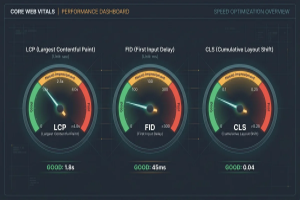
For most Swiss and DACH sites, Largest Contentful Paint (LCP) offers the strongest correlation between technical improvement, ranking movement, and conversion rate change. This is not because Interaction to Next Paint (INP) and Cumulative Layout Shift (CLS) do not matter. But LCP controls when a user perceives a page as loaded, shaping bounce behavior and search evaluation. If your team can only prioritize one metric, the evidence points toward LCP.
LCP measures how long the largest above-fold element takes to render. INP gauges responsiveness. CLS tracks visual stability. Google has treated page experience as a ranking signal since 2021, but frames it as one among many. Cal Poly’s research on technical SEO optimization confirms content relevance and authority remain primary determinants, with page experience as a differentiator.
Backlinko’s analysis of 3.2 million pages found LCP correlated more strongly with first-page rankings than FID or CLS. Akamai and Deloitte independently reported that reducing LCP by one second improved e-commerce conversions by 8–10 percent. A user who sees content faster is more likely to stay, scroll, and convert.
Research from Princeton, Georgia Tech, and IIT presented at KDD 2024 on generative engine optimization suggests retrieval systems increasingly favor sources with strong page-experience signals for AI-generated answers. This adds reason to treat technical SEO mastery as a forward-looking investment.
A Swiss e-commerce site we advised had poor LCP on 68 percent of category templates, caused by unoptimized hero carousels and third-party widgets blocking render.
Over eight weeks, the team converted hero images to modern formats with srcset, deferred non-critical scripts, and moved review widgets below the fold on mobile. LCP dropped from 4.2 to 2.1 seconds. Organic traffic rose 12 percent the following quarter, and add-to-cart improved 6.3 percent. Seasonal factors prevent isolating CWV as the sole cause, but the signal was strong enough to expand optimization to product pages.
Fix
Metric
Site Type
Impact
Effort
Priority
Compress/convert hero images
LCP
Content, E-commerce
High
Low–Medium
1
Defer third-party scripts
LCP
All
High
Low
1
Preload critical above-fold assets
LCP
Content, B2B
High
Low
1
Add explicit image dimensions
CLS
All
Medium
Low
2
Reserve space for ad slots
CLS
Publisher
Medium
Low
2
Split long JavaScript tasks
INP
SaaS, Web App
Medium
Medium
3
Reduce main-thread blocking
INP
SaaS, Web App
Medium–High
High
3
Implement font-display: swap
CLS
All
Low–Medium
Low
2
Lazy-load offscreen images
LCP
Content, E-commerce
Medium
Low
2
Optimize server response (TTFB)
LCP
All
High
Medium–High
1–2
Swiss B2B sites should start with preloading and server response fixes. E-commerce should prioritize image compression and script deferral. SaaS platforms face harder INP work but should handle quick LCP wins first.
Google says page experience is a ranking signal “among hundreds” and does not override content quality. A site with excellent LCP but thin content will not outrank authoritative competitors. Seasonality and algorithm updates confound the signal. INP and CLS matter in specific contexts: high CLS on a checkout page tanks conversions even with fast LCP, and slow INP on a configurator tool destroys engagement. The Princeton/Georgia Tech/IIT GEO framework remains early research, not confirmed.
Run PageSpeed Insights or CrUX data filtered by template type, not domain-wide averages. Identify page groups with traffic volume and poor LCP scores. That intersection is your first sprint.
If you need e-commerce SEO strategies that integrate technical performance with content, prioritize revenue-generating templates first. See our SEO secrets and playbook for broader guidance, or e-commerce SEO results for connecting fixes to revenue.
Does Google penalize sites that fail Core Web Vitals?
No. Google does not apply a manual penalty. Page experience acts as a lightweight ranking factor. A site can rank well with mediocre CWV if content and authority are strong.
How long until ranking changes appear after improving LCP?
Most sites see measurable traffic shifts within four to eight weeks, assuming fixes are deployed site-wide and other factors remain stable.
Should I focus on LCP even if CLS or INP scores are worse?
Generally yes for the first sprint. LCP fixes are faster to implement and show clearer business correlation. If CLS exceeds 0.25 or INP blocks critical journeys, address those after.
Do Core Web Vitals affect local search differently?
Local rankings remain dominated by relevance, distance, and prominence. Page experience may act as a tiebreaker in dense markets like Zürich, but will not compensate for missing location signals.
Is INP more important than FID was?
INP is broader and stricter, measuring latency across the full page lifecycle. For interaction-heavy sites it is more meaningful, though LCP still offers the easier path for most publishers.
Explore premium link-building options to boost your online visibility.