Dynamic pricing has transformed revenue management across the hospitality industry. Hotels adjust rates in real-time based on demand fluctuations, competitive positioning, inventory availability, and dozens of other variables. The revenue benefits are substantial: properties implementing sophisticated dynamic pricing typically achieve five to fifteen percent revenue premium over static pricing strategies. Yet this same capability, when deployed without sufficient attention to customer perception, actively destroys the trust upon which long-term hospitality relationships depend.
The trust challenge manifests in multiple dimensions. Guests who discover they paid significantly more than others for identical accommodations feel exploited, regardless of the economic logic behind pricing differentials. Loyal customers penalized with higher rates during peak demand periods question the value of their loyalty. Travelers who see prices change between search and booking experience frustration that translates into brand rejection.
The fundamental tension lies between revenue optimization and price fairness perception. Economic theory treats pricing as pure supply-demand mechanics, but consumer psychology introduces fairness judgments that profoundly affect behavior and sentiment. Research in behavioral economics consistently demonstrates that perceived unfair pricing generates more negative response than objectively equivalent but transparently justified pricing.
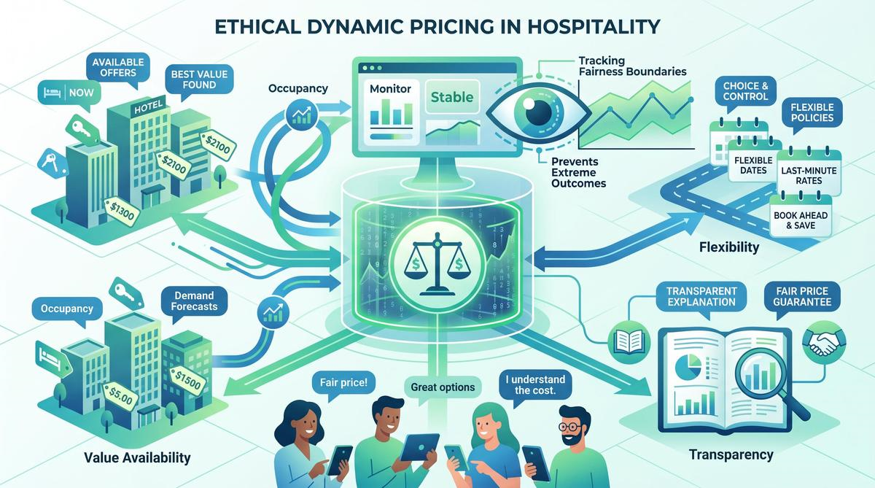
Successful hospitality dynamic pricing requires explicit fairness architecture. Rate variance justification mechanisms explain why prices differ: seasonal demand patterns, advance purchase discounts, package inclusions, or loyalty status benefits. Transparency about pricing logic, even when the resulting rates are high, generates greater acceptance than opaque pricing that guests suspect reflects opportunistic gouging.
Personalized pricing, enabled by AI analysis of individual willingness-to-pay signals, presents particular trust risks. When guests discover that their personal data drives differentiated pricing, backlash can be severe. Hospitality brands must establish clear principles about what customer data informs pricing decisions and provide meaningful opt-out mechanisms for those uncomfortable with personalized approaches.
Education and skill development in revenue management ethics help hospitality professionals navigate these complexities. Platforms like https://coursera.org offer courses in hospitality management, behavioral economics, and customer experience strategy that equip revenue managers with frameworks for optimizing pricing while maintaining trust, providing evidence-based approaches to this challenging balance.
Rate integrity policies establish boundaries that protect trust. Guarantees against post-booking rate decreases, best-price assurances for direct bookings, and clear cancellation terms reduce the anxiety that dynamic pricing creates. While these policies may sacrifice some theoretical revenue optimization, they preserve the trust that generates repeat business and positive word-of-mouth.
Communication strategy shapes pricing perception decisively. How price changes are presented matters as much as the changes themselves. Framing rate increases as responses to high demand from fellow travelers, rather than algorithmic extraction, activates social proof rather than exploitation perception. Messaging that emphasizes value and experience rather than transaction mechanics reinforces hospitality relationship norms.
Technology implementation affects trust directly. Glitchy pricing systems that display inconsistent rates across devices, fail to honor quoted prices, or change rates during booking completion create immediate and lasting trust damage. Pricing infrastructure must meet higher reliability standards than typical e-commerce because hospitality purchases carry greater emotional and financial weight.
Loyalty program integration provides trust-preserving pricing mechanisms. Members who receive transparent, predictable benefits from dynamic pricing programs, such as guaranteed lowest rates, exclusive member pricing, or points-based redemption options, perceive dynamic pricing as serving their interests rather than extracting from them.
Competitive monitoring ensures pricing remains within market norms that guests accept as reasonable. Even sophisticated revenue management systems should incorporate fairness constraints that prevent rates from diverging so dramatically from competitive benchmarks that guest perception shifts from market-responsive to exploitative.
Key Takeaways: - Dynamic pricing generates substantial revenue gains but risks destroying guest trust through perceived unfairness - Transparency about pricing logic and explicit fairness architecture increase acceptance of rate variance - Rate integrity policies and loyalty integration provide trust-preserving frameworks for revenue optimization - Communication framing and competitive benchmarking prevent dynamic pricing from crossing into perceived exploitation
Resources: - https://coursera.org